Phishing Protection for Businesses: What an Email Security Gateway Must Deliver
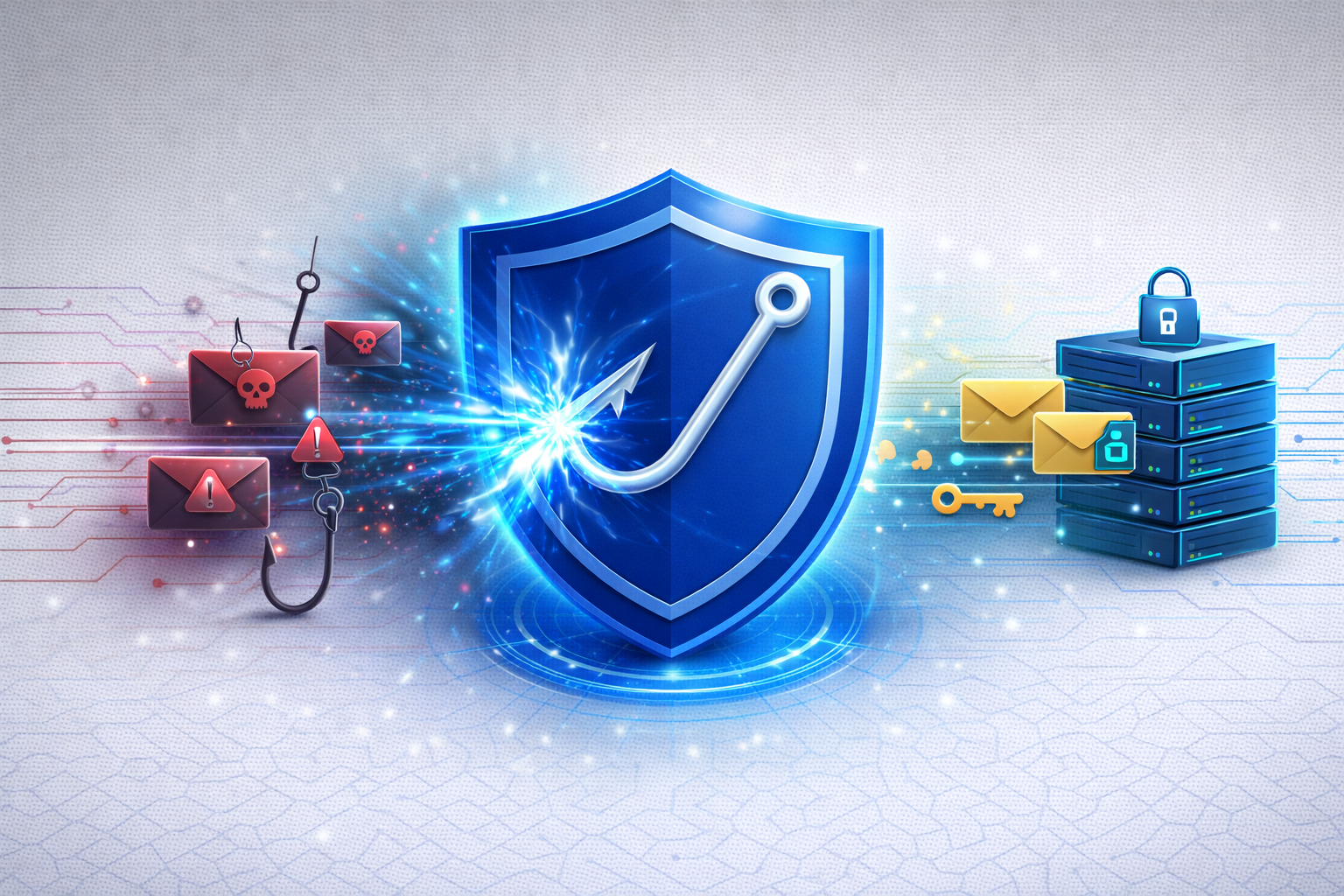
TL;DR: 90% of all successful cyberattacks begin with a phishing email. Training alone is not enough – businesses need technical protective measures at the gateway level. Conbool MailGuard detects spear phishing, BEC, and CEO fraud through AI-based analysis, deep link inspection, and sender verification before the email reaches the inbox.
Phishing is not a new threat – but it is becoming increasingly sophisticated. While classic spam is easy to spot, today's attackers use highly personalized emails that can deceive even experienced employees. According to the BSI Situation Report 2024, phishing remains the most common cause of successful cyberattacks on German companies.
What Types of Phishing Attacks Exist?
Mass Phishing
The simplest form: thousands of identical emails with generic subject lines like "Your account has been locked." These attacks rely on volume and are mostly detected by modern spam filters.
Spear Phishing
Targeted attacks on specific individuals or departments. The attacker researches the company, uses internal terminology, and imitates known business partners. These emails are nearly indistinguishable from legitimate business correspondence for content filters.
Business Email Compromise (BEC)
The attacker impersonates a supervisor, CEO, or finance department and requests a wire transfer or the disclosure of sensitive data. BEC emails contain neither malware nor suspicious links – they are purely text-based and rely on social manipulation.
CEO Fraud
A subtype of BEC: the attacker imitates the CEO and instructs the accounting department to execute an urgent payment. According to the BKA Federal Cybercrime Situation Report, CEO fraud causes damages in the hundreds of millions of euros annually in Germany.
Why Awareness Training Alone Is Not Enough
Security awareness training is important, but it is not a reliable defense:
- Error rate remains: Even after intensive training, 5-10% of employees click on phishing links (Source: Proofpoint State of the Phish 2024).
- Stress and time pressure: Under pressure, attention drops. A well-timed attack on a Friday evening has higher success rates.
- Quality of attacks is increasing: AI-generated phishing emails are linguistically flawless and contextually appropriate.
- A single click is enough: It only takes one employee clicking on a link to compromise the entire network.
The most effective strategy is defense in depth: technical protective measures as the first line of defense, awareness as the second.
What Must an Email Security Gateway Deliver?
1. AI-Based Pattern Recognition
Instead of only reacting to known signatures, a modern gateway analyzes the context of the email:
- Writing style and tone (does the email deviate from the usual communication pattern?)
- Sender behavior (does this sender normally send to this person?)
- Urgency patterns (is unusual time pressure being created?)
2. Deep Link Analysis
Links in phishing emails often lead through redirect chains to a credential harvesting page. A gateway must:
- Resolve URL shorteners
- Follow redirect chains to the final destination
- Render and analyze the target page in an isolated environment
- Check domain age and SSL certificates
3. Sender Verification
Technical verification of sender authenticity:
- SPF: Is the sending server authorized?
- DKIM: Was the email altered in transit?
- DMARC: What should happen if verification fails?
- Header analysis: Does the displayed sender match the technical sender?
4. Sandbox Analysis for Attachments
Suspicious attachments are opened in an isolated environment and examined for malicious behavior – without risk to the corporate network.
How Does Conbool MailGuard Protect Against Phishing?
Conbool MailGuard combines all four protective layers in an upstream gateway:
| Protective Layer | Function | Detection Rate |
|---|---|---|
| Reputation filter | Block known spam senders | >99% for mass spam |
| AI analysis | Contextual assessment of spear phishing | High |
| Deep link analysis | Check and detonate URLs in real time | High |
| Sandbox | Execute and observe attachments in isolation | High for zero-day |
| Sender verification | SPF/DKIM/DMARC + header analysis | Reliable for spoofing |
The integration with Microsoft 365 and Exchange Online is done via an MX record change and can be completed in less than one hour.
How Do I Know If My Business Is at Risk?
Typical warning signs:
- Employees regularly report suspicious emails in their inbox
- There have already been successful phishing attempts (even without damage)
- You use Microsoft 365 without an additional email security gateway
- Your organization has more than 50 employees or processes sensitive data
- You fall under the NIS2 directive or CRITIS regulation
Frequently Asked Questions
How quickly does MailGuard detect new phishing campaigns?
MailGuard uses AI-based detection that does not rely on signatures. New phishing patterns are detected in real time – without waiting for signature updates.
What happens to an email identified as phishing?
The email is placed in quarantine. Administrators receive a notification and can release the email if it turns out to be a false positive.
Can MailGuard also detect internal phishing simulations?
Yes, but you can configure whitelists for internal simulation tools so that your awareness training campaigns are not affected.
How does MailGuard differ from Microsoft Defender for Office 365?
Microsoft Defender operates within the Microsoft infrastructure. MailGuard sits in front of it as an independent protective layer and filters threats before they reach Microsoft – a defense-in-depth approach as recommended by the BSI. Read more in our comparison article: Why the Microsoft 365 Spam Filter Alone Is Not Enough.
Conclusion
Phishing protection is not an optional add-on but a business-critical investment. The combination of technical gateway protection and employee awareness forms the most effective defense.
Conbool MailGuard provides this technical protective layer: AI-based, upstream, and seamlessly integrated into existing email infrastructures.
Start your free trial or contact us for a personalized consultation.