Why Is Choosing the Right Encryption Method Critical?
TL;DR: S/MIME and PGP are the two established standards for end-to-end email encryption, but they differ fundamentally in trust model, integration, and enterprise suitability. S/MIME relies on central certificate authorities and is natively integrated into Outlook. PGP is based on the decentralized Web of Trust and is widespread in the open-source community. The best solution for businesses: A gateway like Conbool SecureMail that automatically supports both methods in parallel.
Email remains the most widely used communication tool in the business environment. According to a Bitkom study, German companies send an average of 40 business emails per employee per day. At the same time, BSI reports show that email remains the most common attack vector for cybercriminals.
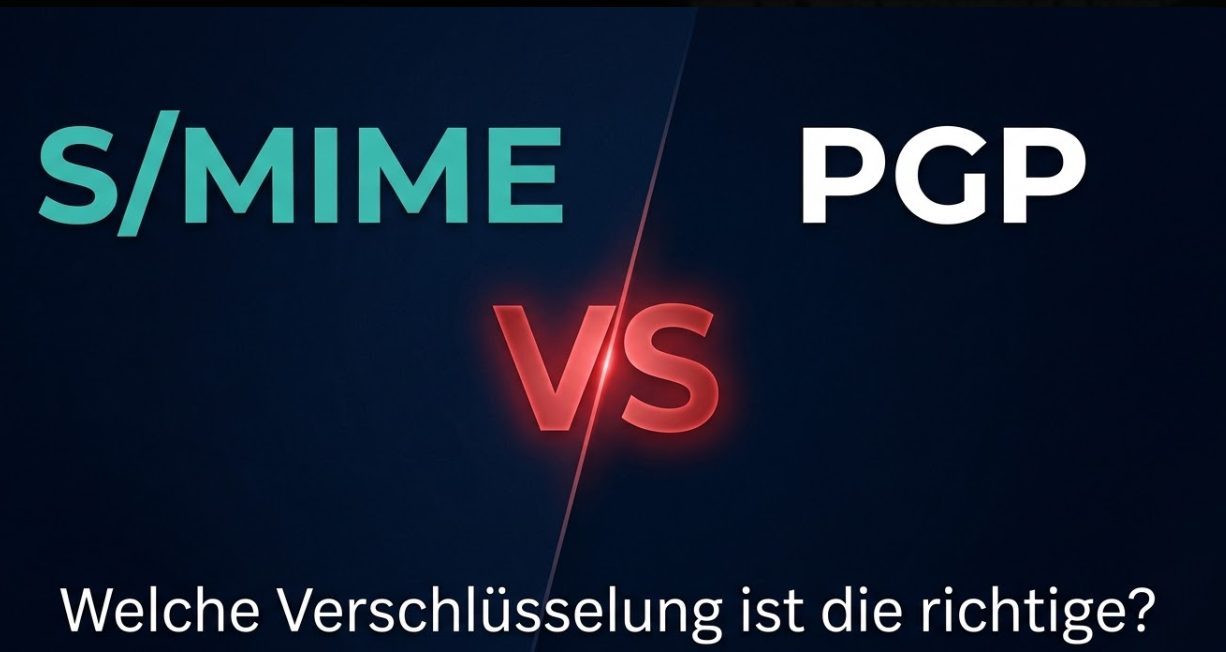
Anyone looking to secure their business communication inevitably faces the question: S/MIME or PGP? Both methods enable end-to-end encryption and digital signatures but take fundamentally different approaches. This article provides a detailed comparison of both technologies and shows why the either-or question is actually outdated in modern IT strategy.
How Does S/MIME Work and What Are the Benefits?
S/MIME (Secure/Multipurpose Internet Mail Extensions) is a standard for encrypting and digitally signing emails based on the principle of hierarchical certificate authorities (CAs). The method was originally developed by RSA Security and is now standardized in RFCs 8551 and 5750.
The S/MIME Trust Model
With S/MIME, each user receives a digital certificate from a recognized certificate authority. This CA verifies the applicant's identity and vouches with its own signature that the certificate is authentic. The trust model works hierarchically: Your email client trusts a set of root CAs, and any certificate issued by these CAs is automatically considered trustworthy.
This approach has decisive advantages for businesses:
- Verified identity: The recipient can be certain that the email actually comes from the stated sender, because an independent body has verified the identity.
- Native integration: Microsoft Outlook, Apple Mail, and most business email clients support S/MIME natively – without additional plugins or software.
- Central manageability: IT departments can manage S/MIME certificates centrally via a gateway or PKI infrastructure, which is indispensable when dealing with hundreds or thousands of employees.
- Compliance conformity: S/MIME certificates from recognized CAs meet the requirements of numerous regulations, including GDPR, NIS2, and industry-specific requirements such as BAIT in the banking sector.
Typical Use Cases for S/MIME
S/MIME is the preferred method in regulated industries. Banks, insurance companies, government agencies, and healthcare organizations rely on S/MIME because certificate-based identity verification meets strict compliance requirements. In communication between companies and their customers or business partners, S/MIME is often the first choice as well, since CA verification builds trust without requiring communication partners to meet in person or exchange keys manually.
A concrete example: A law firm sending confidential client information via email needs a method that unambiguously proves the sender's identity while simultaneously ensuring the confidentiality of the contents. S/MIME fulfills both requirements and integrates seamlessly into the existing Outlook infrastructure.
How Does PGP Work and Where Are Its Strengths?
PGP (Pretty Good Privacy) was developed in 1991 by Phil Zimmermann and takes a radically different approach from S/MIME. Instead of relying on central trust authorities, PGP is based on the so-called Web of Trust – a decentralized network in which users mutually confirm the authenticity of each other's keys.
The Web of Trust
Each PGP user creates a key pair consisting of a public and a private key. The public key is distributed – for example via key servers or directly to communication partners. The distinctive feature: There is no central authority that certifies keys. Instead, users sign each other's keys and thus build a trust network.
PGP's strengths lie in the following areas:
- Decentralization: No dependency on a central authority. The user retains full control over their keys.
- Open-source availability: OpenPGP is an open standard (RFC 4880), and there are numerous open-source implementations such as GnuPG. The code can be independently audited.
- Flexibility: PGP can be used not only for emails but also for encrypting files, hard drives, and software packages.
- Cost-free: Unlike S/MIME, where certificates must be purchased from a CA, using PGP is fundamentally free of charge.
Typical Use Cases for PGP
PGP is traditionally widespread in the open-source community, in software development, and among technically savvy users. Journalists use PGP to protect confidential sources. NGOs and activists rely on the decentralization of the Web of Trust to protect themselves from government surveillance. In software development, PGP is used to sign releases and commits, ensuring code integrity.
A practical example: A technology company that collaborates with open-source communities and whose developers work on Linux systems will find PGP to be the natural choice, as it is deeply integrated into toolchains and reflects the community's decentralized philosophy.
How Do S/MIME and PGP Compare Head to Head?
The following table contrasts both methods based on the most important criteria for businesses:
| Criterion | S/MIME | PGP |
|---|---|---|
| Trust Model | Hierarchical (Certificate Authority) | Decentralized (Web of Trust) |
| Identity Verification | Verified by independent CA | Self-certified or confirmed by peers |
| Outlook Integration | Natively supported, no plugins needed | Plugin required (e.g., Gpg4win) |
| Automation Capability | High – central certificate management possible | Limited – key exchange often manual |
| Cost | Certificate fees (approx. EUR 15–80/year per user) | Fundamentally free (OpenPGP) |
| Compliance Suitability | Very high – recognized in regulated industries | Medium – lacking central certification |
| Enterprise Readiness | High – scales via gateway solutions | Low – manual management with many users |
| Key Distribution | Automatic via CA and LDAP | Manual via key servers or direct exchange |
| Legal Recognition | Qualified certificates under eIDAS possible | No formal legal recognition |
| Interoperability | High between companies with CA certificates | High within the PGP community |
When Should Your Company Choose S/MIME?
S/MIME is the right choice when your company has the following requirements:
Regulated industries: If you operate in finance, healthcare, or public administration, you will frequently encounter communication partners who expect S/MIME as the standard. Certificate-based identity verification is explicitly required in many regulations.
Microsoft environments: If your company uses Microsoft 365 or Exchange Online, S/MIME offers the most seamless integration. Employees can send and receive encrypted emails without changing their workflow.
Large organizations: Beyond a certain company size, PGP's manual key management becomes impractical. S/MIME certificates can be managed through a central PKI or gateway in an automated fashion.
Customer communication: If you want to communicate encrypted with external partners who have no technical expertise in cryptography, S/MIME is the lower-barrier option, as the recipient only needs a certificate and verification happens automatically through the CA.
When Is PGP the Better Choice?
PGP has its place in certain scenarios:
Technical teams: Development teams that already work with GPG-signed commits will find PGP to be a natural extension of their existing security infrastructure.
Communication with the open-source community: If your company works intensively with open-source projects, PGP is often the only common denominator for encrypted communication.
Budget constraints: For smaller organizations that do not want to bear CA fees and have the technical know-how, PGP offers a cost-free alternative.
Maximum independence: Companies that do not want to depend on a central certificate authority will find in PGP a method that allows full control over the key infrastructure.
Why Is the "S/MIME or PGP" Question Actually Outdated for Modern Businesses?
In practice, companies rarely face a pure either-or decision. A mid-sized company's communication partners use different methods: Banks and government agencies use S/MIME, technical partners use PGP, and many recipients have no encryption infrastructure at all.
This is exactly where a modern email gateway like Conbool SecureMail comes in. Instead of committing to one method, the gateway supports both standards in parallel and automatically selects the right method for each recipient:
- If the recipient supports S/MIME, the email is encrypted with the corresponding certificate.
- If the recipient has a PGP key, PGP is used.
- If the recipient has no encryption infrastructure, the message is delivered via a secure web portal.
Since September 2026 the recipient is no longer the only deciding factor. A rule can also be tied to the message itself: whether it carries an attachment, what file type that is, and how large the mail becomes. The old question "S/MIME or PGP" turns into a question of occasion — plain text signed and S/MIME-encrypted, a contract in the attachment as a password-protected PDF. Two rules, and nobody has to think about it while writing.
This approach solves several problems at once:
No manual effort for end users: The sender simply clicks "Send." The gateway handles all cryptography – key lookup, certificate validation, encryption, and signing.
Central certificate and key management: IT administrators manage all S/MIME certificates and PGP keys in one place. Certificates are automatically requested, renewed, and revoked when needed. According to internal measurements, this saves an average of 15 hours per month in administration effort.
Maximum reach: By supporting both methods plus web portal fallback, you can communicate encrypted with any recipient – regardless of their technical equipment.
Compliance at the push of a button: All encryption processes are comprehensively logged. Whether GDPR audit, NIS2 evidence, or industry-specific review: The gateway automatically provides the necessary documentation.
As we described in detail in our article on digital sovereignty through automated email encryption, the automation of key management is the decisive factor in whether email encryption works in practice or only exists on paper.
What Role Does the Provider's Location Play in the S/MIME vs PGP Comparison?
Regardless of whether you use S/MIME, PGP, or both methods, another factor is critical: Where are your keys stored? If the encryption infrastructure is with a US provider, the Cloud Act potentially applies – and your end-to-end encryption is nothing more than an illusion.
Conbool is a German company headquartered at CyberLab Karlsruhe, one of Europe's leading accelerator programs for cybersecurity. All keys and certificates remain under the legal jurisdiction of German data protection law – with no obligation to surrender them to foreign authorities.
Practical Scenarios: S/MIME, PGP, or Both?
Scenario 1: Mid-Sized Manufacturing Company
A machine builder with 500 employees communicates with suppliers in Europe, banks, and government agencies. The IT department consists of five people. Recommendation: S/MIME as the primary method via a central gateway. The native Outlook integration minimizes training effort, and the CA-based identity verification meets business partners' requirements.
Scenario 2: Software Company
A technology company with 200 employees develops open-source software and works closely with international developer communities. Recommendation: Both methods in parallel. S/MIME for customer communication and business transactions, PGP for collaboration with the developer community. A gateway like SecureMail automatically selects the right method.
Scenario 3: Financial Services Provider
A wealth management firm with strict BaFin requirements must demonstrate that all emails containing personal data are encrypted. Recommendation: S/MIME with qualified certificates and comprehensive logging. The gateway documents every encryption process for compliance audits.
Frequently Asked Questions
Can I use S/MIME and PGP simultaneously in my company?
Yes, but without a central gateway this involves considerable administrative effort. Each employee would need to manage both an S/MIME certificate and a PGP key pair. A SecureMail Gateway solves this problem by centrally managing both methods and automatically selecting the appropriate method for each recipient.
Is S/MIME more secure than PGP or vice versa?
From a cryptographic perspective, both methods offer a comparable security level. The differences lie in the trust model: S/MIME relies on the diligence of the certificate authority, PGP on the diligence of users in the Web of Trust. For businesses, S/MIME is often the more practical choice because the central trust authority reduces administrative effort and better covers compliance requirements.
What happens when an S/MIME certificate expires?
Expired certificates mean that the recipient can no longer verify the digital signature and cannot send encrypted emails to the affected sender. In manual management, this is a common error. With a gateway like Conbool SecureMail, certificates are automatically renewed before expiration – outages due to forgotten renewals are a thing of the past.
How do I integrate email encryption into my existing Microsoft 365 environment?
Integration takes place at the gateway level. The MX record is pointed to the SecureMail Gateway, which operates as a transparent proxy between your Microsoft 365 or Exchange Online system and the internet. End users notice no change in their workflow. The entire setup typically takes less than one day.
Conclusion: The Right Strategy Instead of the Right Technology
The S/MIME vs PGP comparison shows: Both methods have their place, but for most businesses, the decision for a single method is no longer appropriate. The diversity of communication partners demands flexibility.
An intelligent gateway that supports both standards and automates the complexity of key management is the strategically smarter investment than committing to a single method. It gives your company the freedom to communicate securely with any partner – without burdening your IT department with manual management of cryptographic infrastructure.
Want to find out which encryption strategy fits your business? Contact us for a personalized consultation. Also learn why digital sovereignty in email encryption is essential and how Conbool as a startup at CyberLab Karlsruhe is setting new standards for email security.