What Is PGP Encryption? How It Works and Business Use Cases
PGP encryption (Pretty Good Privacy) is currently back in high demand and is one of the most widely used standards worldwide for secure email communication, based on the open OpenPGP standard. While awareness of digital data protection continues to grow – we are currently seeing a massive surge in interest in this method – many IT departments face the challenge of efficiently integrating PGP into daily operations. In this guide, you will learn how the system works and how you can encrypt every email without compromising your employees' productivity.
PGP Explained: The Principle of Asymmetric Cryptography
TL;DR: PGP (Pretty Good Privacy) encrypts emails using asymmetric cryptography with a public and a private key. The method is highly secure but often fails in everyday business due to manual key management. Automated gateway solutions like Conbool SecureMail handle key detection, encryption, and secure delivery centrally in the background, making PGP practically usable.
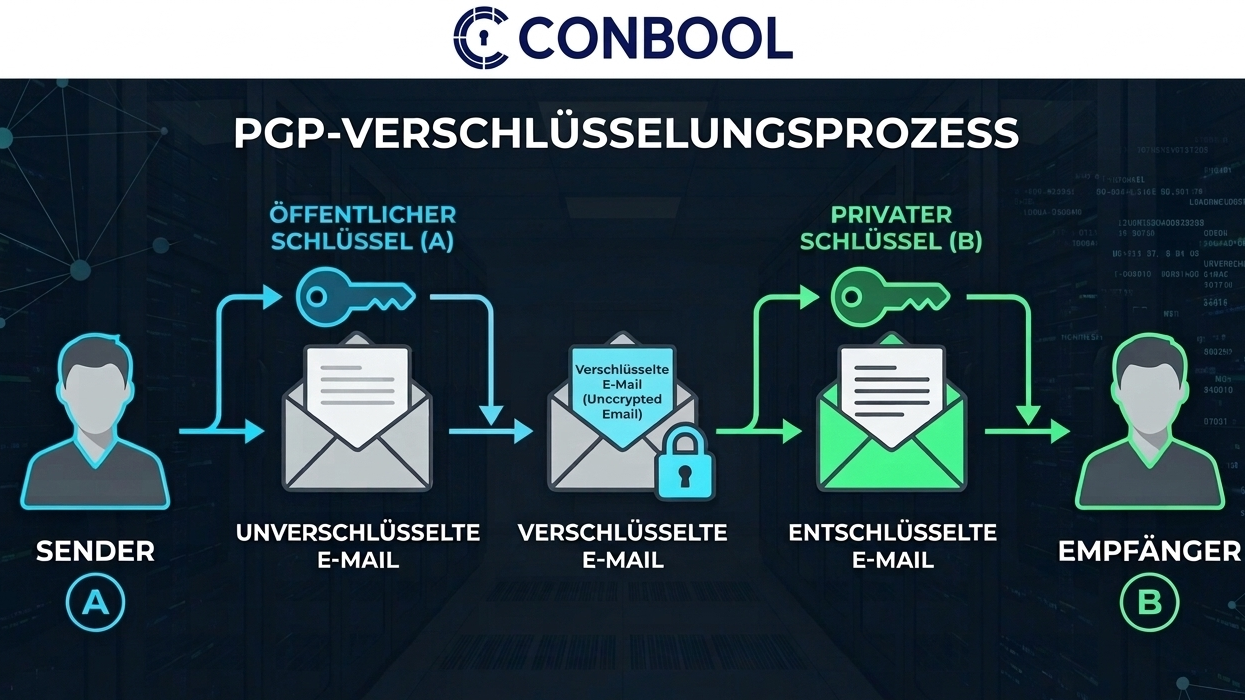
At its core, PGP technology is based on asymmetric encryption. The BSI recommends key lengths of at least 2048 bits for asymmetric methods in its cryptography guidelines. Unlike simple passwords, this method uses a key pair:
- Public Key: This is freely distributed and is used to encrypt messages to you.
- Private Key: This remains securely with you and is the only key that can make received data readable again.
This system ensures that only the intended recipient can view the content of an email, even if the message is intercepted during transmission.
Why PGP Often Becomes a Hurdle for Businesses
Despite the high level of security, manual PGP implementations in companies frequently fail due to complexity. The manual search for the matching public key of a partner or the laborious certificate management overwhelms users in the stressful office routine. Without automation, email encryption often remains patchy and leads to compliance risks.
The Solution: Automated Email Encryption at the Gateway
Modern businesses therefore rely on a central Secure Mail Gateway. Solutions like Conbool SecureMail automate the entire PGP process in the background:
- Automatic Detection: The gateway independently detects whether a PGP or S/MIME key exists for a recipient.
- Server-Based Encryption: The process takes place centrally on the server, without employees needing to operate additional plugins in Outlook.
- Secure Delivery: If the recipient lacks a matching key, the message is automatically delivered securely via an integrated message portal.
FAQ: Frequently Asked Questions About PGP
Is PGP more secure than S/MIME? Both methods are considered very secure. The main difference lies in the trust model (Web of Trust with PGP vs. hierarchical certificates with S/MIME). For businesses, the combination of both standards is often ideal.
Can I use PGP with Outlook? Outlook does not natively support PGP. Businesses need either complex plugins or – much more efficiently – a central gateway that handles the encryption for all devices.
How much does PGP encryption cost? While individual users often use free tools, businesses invest in professional solutions for automated key management to sustainably reduce administration and support costs.
Also read our detailed comparison: S/MIME vs PGP — Which Encryption Is Right?